 MineBrush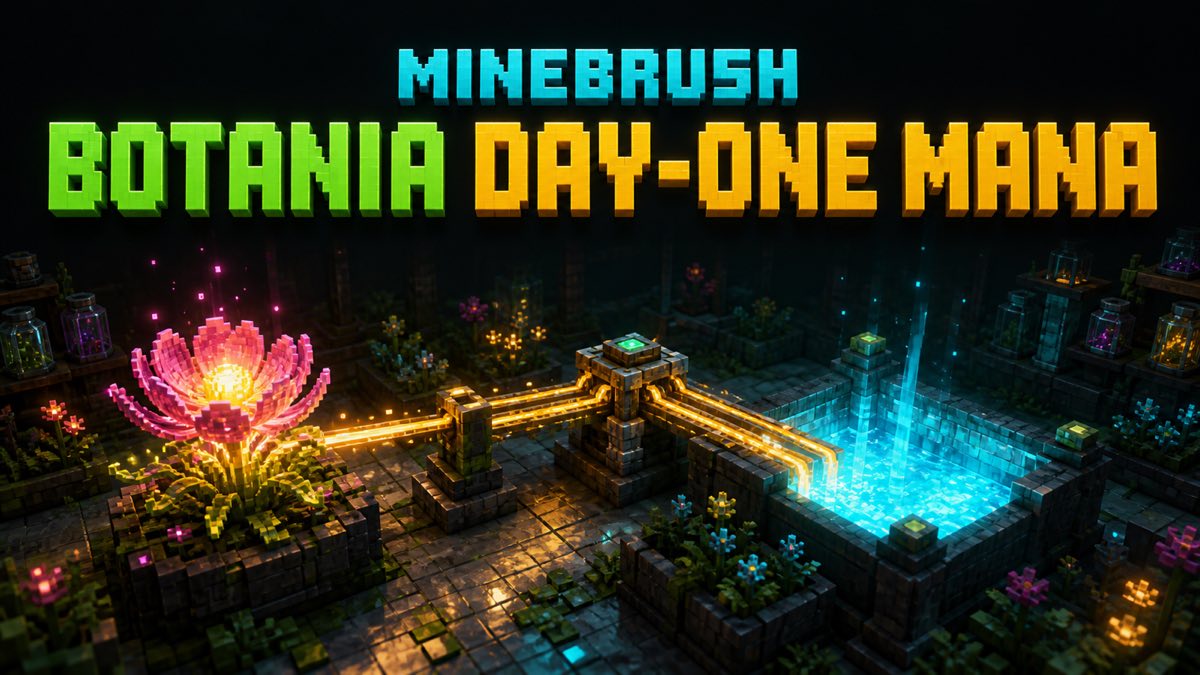
Botania looks like a magic mod, plays like a tech mod, and teaches almost everything through blocks in the world. That combination is why new players either click with it immediately or spend a night staring at a flower that appears to do absolutely nothing.
The fix is not a bigger build. It is a smaller loop. This guide follows current creator sources checked on August 25, 2026 and stops at the first useful mana setup. MineBrush did not launch Botania for this package, so exact recipes, timing, keybinds, and modpack behavior remain tied to your installed build. Keep the in-game Lexica Botania open and treat it as the final recipe screen.
Quick route: flower, spreader, pool
Your day-one goal is a chain you can inspect:
- Match Minecraft, loader, Botania, and the required library mods.
- Craft the Lexica Botania and learn how to open entries from blocks.
- Use the Petal Apothecary and Pure Daisy progression to obtain Livingwood and Livingrock.
- Make the Wand of the Forest, a Mana Spreader, a Mana Pool, and one beginner generating flower.
- Confirm the flower is bound to the spreader and the spreader targets the pool.
- Feed one safe fuel item, watch the path, and stop before scaling.
If that single line works in your profile, you have learned the core language of the mod. If it does not, adding five more flowers only multiplies the mystery.
Install the exact dependency lane
The creator-owned Botania project page currently lists Minecraft 1.20.1 among its supported branches, with Fabric, Forge, and Quilt shown as platforms. It also states that Botania requires Patchouli and either Curios for Forge or Trinkets for Fabric/Quilt. Those are different loader lanes; do not collect every dependency name into one instance.
On the source day, the Modrinth API lists Botania 1.20.1-455 as a release in separate Forge and Fabric/Quilt files published August 21, 2026. That is a dated checkpoint, not an evergreen “latest” promise. Match the exact Minecraft branch and loader on every file page when you install.
Start with a clean launcher profile containing only the loader, Botania, Patchouli, and the correct accessory library. Reach the title screen, create a disposable test world, then add the rest of your modpack in small groups. A clean profile cannot prove compatibility, but it gives every later failure a readable starting point.
The Lexica is part of the machine
The official web Lexica Botania says its online text is fed from the bleeding-edge Patchouli book and may be ahead of the currently available mod. That warning matters. Use the website to understand concepts and use the in-game book from your installed version for recipes, unlock state, and exact interaction details.
The Lexica describes Botania as a natural-magic tech mod built around Mana, automation, and in-world interaction. It also encourages players to read basic entries and use the index. That is not flavor text to skip. Botania deliberately avoids many conventional machine GUIs, so the book, the Wand of the Forest, particles, and block state are your dashboard.
Step 1: build the living-material bridge
The Petal Apothecary accepts water and the ingredients for magical flowers; the in-game book shows the recipe for your branch. The Pure Daisy then transforms adjacent wood and stone into Livingwood and Livingrock. Those two materials unlock the first mana-handling blocks.
Keep this area simple. Place the Pure Daisy where every adjacent conversion block is visible. Do one material at a time, collect the result, and save a small reserve. If nothing changes, verify the block type and placement against your in-game entry before assuming the mod is broken. The online Lexica describes the transformation as taking roughly a minute, but exact timing belongs to the installed version and server configuration.
This is also your first lesson in Botania troubleshooting: position is data. A block can be present, crafted correctly, and still be outside the relationship a flower expects.
Step 2: place the smallest mana line
A beginner line has three jobs. A generating flower produces mana from its supported input. A Mana Spreader receives the flower’s mana in its internal buffer and sends bursts toward a target. A Mana Pool stores the result.
Put those parts close together with an unobstructed view. The official Lexica says generating flowers auto-bind to a nearby spreader when placed, and the Wand of the Forest can inspect or change bindings. It also says the spreader can be aimed at a target with the wand in Bind Mode. Do not rely on “it looks close enough.” Hold the wand, inspect the relationship, and deliberately aim the spreader at the pool.
Use one pool, one spreader, and one flower until the path is visible. Large decorative layouts are a reward for understanding the line, not a substitute for it.
Step 3: use a modest first generator
The official Lexica presents the Endoflame as a basic generating flower that consumes combustible dropped items one at a time and converts them into mana. It notes several boundaries: fuels that leave furnace byproducts are not accepted, extremely long single fuel items can waste potential, and a simple automated feed is better than dumping a pile forever.
For your first proof, feed one ordinary furnace fuel supported by the in-game entry. Watch the flower, spreader buffer, burst path, and pool. Do not throw an entire stack and walk away. A single item gives you a clean checkpoint: accepted or not, producing or not, transferred or not.
When that works, add a controlled feed later. The Lexica suggests an Open Crate plus an output limiter as a direction for automation. This guide does not prescribe a timer because server rate, version, and pack balance were not tested here.
Read the line with the Wand of the Forest
The Wand is not just a crafting ingredient. The Lexica documents it as the inspection and binding tool for spreaders and pools. With the wand in hand, nearby spreaders expose their aiming path and target. The pool shows its mana level, though a normal pool is intentionally large and its bar may move slowly at first.
That slow bar can fool beginners into rebuilding a working system. Instead, debug from left to right:
- Input: did the generating flower accept the item?
- Binding: is the flower connected to the intended spreader?
- Buffer: does the spreader show stored mana?
- Aim: does its visible path terminate at the pool?
- Storage: does the pool respond over repeated cycles?
Change only the first failed checkpoint. Rotating every block at once destroys the evidence you just collected.
Five common day-one failures
- Wrong dependency lane: Forge accessory support is not the same file choice as Fabric/Quilt.
- Web recipe mismatch: the online Lexica can be ahead; follow the in-game book for your installed version.
- Unbound flower: proximity did not produce the connection you expected; inspect with the wand.
- Spreader not aimed: mana is buffered but the target path misses the pool.
- Fuel misunderstanding: the item is not accepted, leaves a container, or is a poor first proof.
On a server, add two more checks: is the chunk active under the server’s rules, and did the server owner alter Botania configuration or recipes? Those are questions, not claims that Botania requires chunk loading or uses a particular default.
When to scale—and when to stop
Scale after you can explain every block in the line. Add a second flower only when the first flower’s input, binding, and output are understood. Add automation only when manual feeding is stable. Move the setup only after you can rebind it intentionally.
Stop and return to a disposable world if your modpack changes recipes, removes entries, alters fuels, or includes progression gates that the standard Lexica does not describe. Do not copy a late-game build from a different pack and call it a beginner setup.
Evidence boundary
Current creator sources support the project branch/loader/dependency statements, the source-day 1.20.1-455 file tuple, and the conceptual chain from Pure Daisy materials to generating flower, spreader, pool, wand inspection, and controlled Endoflame fuel. The static MineBrush fixture bundled with this article checks only that the learning sequence keeps those stages in order.
MineBrush has not verified runtime, recipes, exact mana values, timing, server behavior, performance, modpack overrides, or clean-profile screenshots. Keep those as test gates. For more source-first setup routes, visit Minecraft Guides; for the wider Java mod library, use Minecraft Mods.
Your first mana system does not need to be fast. It needs to be legible. Once you can point from flower to spreader to pool and explain what each checkpoint says, Botania stops feeling like a magic trick and starts feeling like a machine you built.
PLAYER QUESTIONS
Discussion
Include the exact edition, version and step when asking for help.