 MineBrush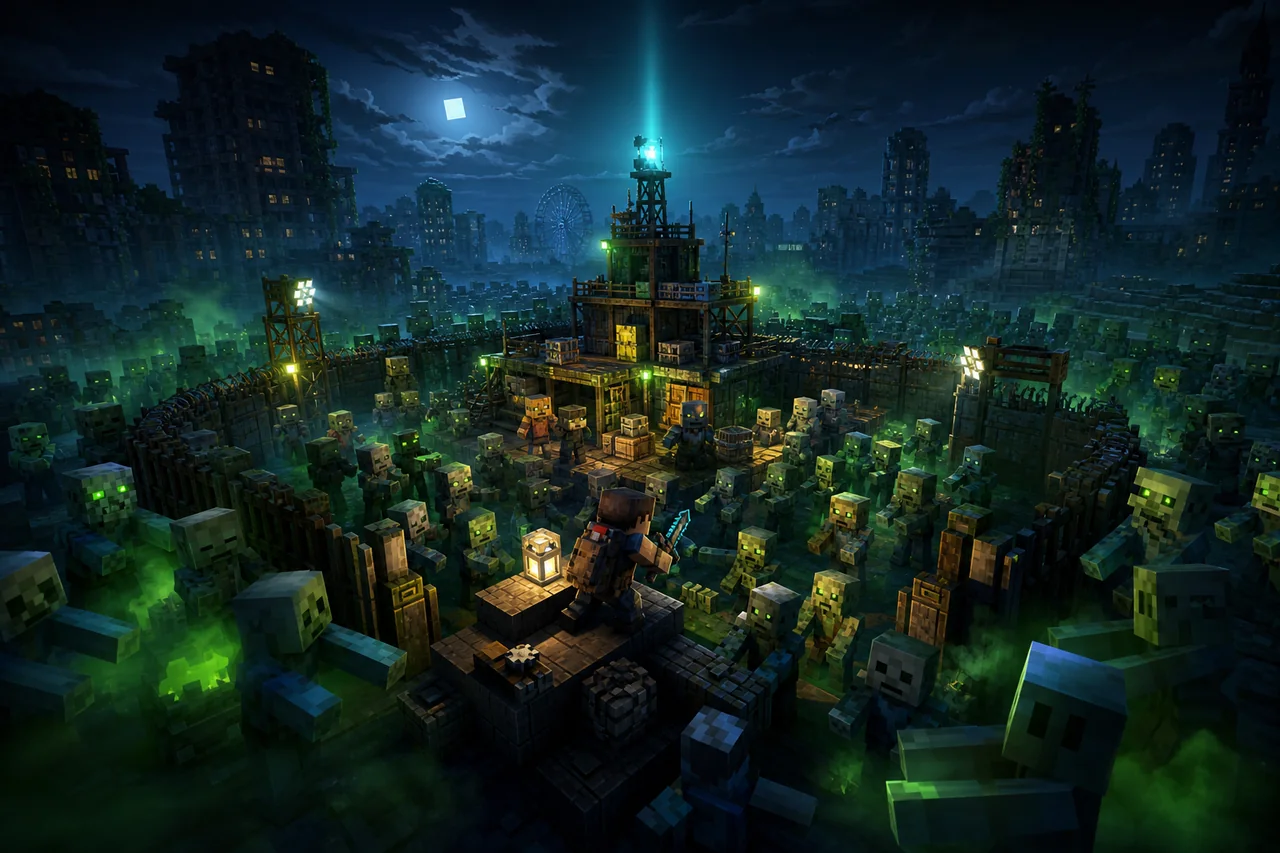
Minecraft Bedrock · Progressive survival horror
Rise and Survive 1.2 is built for a dedicated apocalypse world, not a quick zombie reskin. Its difficulty climbs each day, stronger behavior arrives on eight-day milestones, and Blood Moons force horde encounters that can bypass ordinary base assumptions. The current file is labeled for Bedrock 1.21.130 only, so start by deciding whether your game version and appetite for persistent progression fit the project at all.
Exact project and release
| Creator | Ranzie |
|---|---|
| CurseForge project | 1400032 |
| Selected release | Rise and Survive 1.2 |
| Filename | Ranzie Rise and Survive 1.2.mcaddon |
| File ID | 7379125 |
| Channel and date | Release · December 26, 2025 |
| Displayed size | 16.6 MB |
| Supported build | Bedrock 1.21.130 |
MCPEDL shows a January 19, 2026 page update and the same v1.2 family, but that page date is not a new artifact release. CurseForge still identifies file 7379125 from December 26 as the main release. Two older files are explicitly labeled outdated; they are not fallback recommendations.
There is no current 26.x claim
The exact release card lists only 1.21.130. Importing on a 26.x client may succeed at the archive level while scripts, spawning, UI, blocks, or persistence fail later. MineBrush therefore does not expand the label into an assumed range.
If you already upgraded beyond the listed build, use a disposable test profile only or wait for a creator update. Do not present an unsupported personal test as proof for every phone, console, Realm, or dedicated server.
The calendar is part of the game system
The creator describes a dynamic difficulty bar that rises every day and increases zombie spawn rates. Every eight days, zombies can become faster and stronger and unlock new abilities. Higher difficulty also increases the chance that enemies arrive with armor or weapons.
That means a five-minute launch check misses the central feature. Record day 1, day 8, and at least one later milestone in separate copied worlds or controlled time advances. Track the displayed difficulty, ordinary spawn rate, equipment rate, movement, damage, and whether the same world keeps its progression after a complete restart.
Know what can breach your base
Rise and Survive assigns different jobs to its zombies:
- Miners break blocks and become faster at higher difficulty.
- Block Placers tower and bridge toward elevated players.
- Witch Zombies use potions; Bombers throw damage-only TNT.
- Ender Zombies teleport, Jumpers leap, and Crawlers use small spaces.
- Revealers expose a player's location and retreat; Spitters attack from range.
- Giant, Tank, and Necromancer leaders add jumping/fangs, durability, or summoned reinforcements.
A test base should therefore include a low wall, overhang, narrow opening, elevated platform, ordinary door, and one protected storage area. “Nothing reached me on the roof” is not a useful conclusion until the relevant class has actually spawned at the intended difficulty.
Blood Moon acceptance test
The source says a Blood Moon occurs every eight days, disables sleep, guarantees one or two horde events, and makes zombies aware of the player's location. Ordinary hordes are described as spawning about 15 blocks away, with size scaling through customizable difficulty settings.
- Use a new world with no other mob, sleep, time, or difficulty add-on.
- Record the day and difficulty before the expected event.
- Stand at a measured base position and note first spawn distance, horde size, classes, and path.
- Try sleep once, then follow the intended escape route without changing difficulty.
- Save after the event, close Minecraft fully, and verify the next day and difficulty state.
Do not use a valuable base for this test. Block breaking, bridging, explosives, and persistent progression make rollback more important than visual spectacle.
Infection changes the failure condition
Zombie hits can infect players. The creator says infection probability can be configured from 0 to 100 percent, infected players collapse after a timer, and a Golden Apple is the only cure. The checked source does not expose every default, permission, timer, multiplayer, or persistence rule.
Test with an empty inventory in a marked area. Record the configured chance, first hit, visible feedback, timer, cure, death/collapse result, reconnect, and whether another player sees the same state. If the configuration is unavailable or unclear, do not guess commands in a live community.
World interaction and defenses
Horns and bells attract zombies immediately, while taking damage creates a blood scent detectable up to ten blocks. The add-on also advertises faster Java-style regeneration, craftable gunpowder, structures with loot, melee weapons, and a rotten-flesh progression from raw flesh to cooked flesh to leather.
Defensive blocks include wired and cheval fences, wired walls, chain fencing, spiked plates, and spiked fencing. One source-specific boundary says zombies cannot break chain fencing until difficulty 75. Treat that number as a targeted checkpoint: test below, at, and above the threshold rather than assuming every reinforced block behaves alike.
Visual extras are not required dependencies
The project describes blood-screen effects with compatible visual packs, Fresh Animations-inspired zombie art, block-breaking particles, and glowing eyes with Vibrant Visuals. These statements do not prove that a separate visual pack is required for the core apocalypse or that every visual combination is compatible.
Prove v1.2 alone first. Add one visual pack only after spawning, infection, progression, and defenses pass. If glowing eyes or blood effects change without affecting AI, classify that as a visual-layer difference rather than rewriting the gameplay verdict.
Multiplayer and performance need a horde test
The source supplies no MineBrush benchmark. One player on day 1 is not representative of two clients during a Blood Moon. Record the host device, joining device, simulation distance, difficulty, horde size, entity count if available, frame time, tick delay, memory symptoms, heat, and reconnect behavior.
Run the same marked route on the weakest device before and during a controlled event. Watch block breaking, projectile timing, inventory response, infection messages, and whether both players see the same classes. Realm and dedicated-server behavior remain unknown.
Conflicts to isolate
Other mob replacers, spawn controllers, difficulty systems, time/sleep packs, structures, loot tables, regeneration changes, player-health scripts, animation packs, and weapon add-ons can touch the same layers. Restore them one group at a time after the solo baseline.
The creator's Overgrown Cities project is described as a companion atmosphere, not a required file for v1.2. Treat it as a separate world-generation test with its own version support and backup. Never merge its compatibility statement into Rise and Survive.
Update and removal are world migrations
Progression counters, structures, custom blocks, mobs, loot, and infection state may survive in a save. Export the world before an update. Do not replace the current file with one of the older “outdated” archives or mix internal components across releases.
For removal, use a copy. Finish the active horde, cure or clear the test player, move away from custom structures, remove add-on items, deactivate every component, restart, and revisit the test area. Exact cleanup is unknown because the archive was not inspected.
Troubleshooting the first broken layer
| Symptom | First useful action |
|---|---|
| No progression appears | Confirm file 7379125 on Bedrock 1.21.130, then record day and difficulty in a fresh solo world. |
| Zombies cannot tower correctly | Verify the selected December 26 release; its changelog specifically fixes towering behavior. |
| Vanilla hostile mobs disappear | This is creator-described behavior; their loot is shifted to zombie kills. Do not treat it as a random conflict. |
| Blood Moon timing looks wrong | Remove time/sleep packs, record the day counter, and reproduce across a full save/reopen. |
| Current 26.x client behaves badly | Return to a disposable copy. The exact release lists only 1.21.130. |
| Multiplayer freezes during hordes | Reduce to host plus one client and record event size, simulation distance, tick delay, and the earliest repeatable trigger. |
Rights and media boundary
CurseForge displays “Creative Commons 4.0” without exposing the exact variant or asset scope in the checked page. MineBrush does not infer a mirroring right from that shortened label and leaves the archive and gallery on the creator route.
The workspace contains neither the real v1.2 archive nor an original or creator-supplied gameplay capture for this project. The current cover is editorial artwork, not a tested horde scene.
Primary sources
Source metadata was rechecked August 24, 2026. This guide records creator-described mechanics and a safe evaluation route; it does not claim a successful import, horde, server, or performance result.
Browse more survival projects in the Minecraft Bedrock add-ons hub.
PLAYER QUESTIONS
Discussion
Include the exact edition, version and step when asking for help.